Rust solo survival explained through Blooprint's 14-day Apex Survivor run
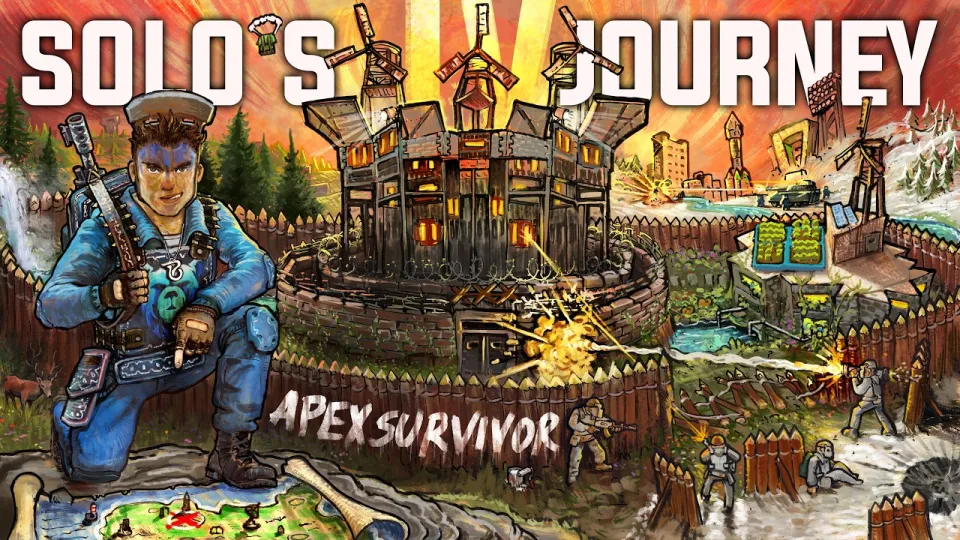
Video: Rust - A Solo's Journey IV: Apex Survivor (Movie)
Want articles like this for your own video to promote it on YouTube and Google? Order them through the Telegram bot @sat_sit_bot. It writes articles around your video, embeds the video and publishes them on popular niche websites (no ads). Free trial — 50 articles.
· based on the channel Blooprint
Key takeaways
- Blooprint survived 14 real days of solo Rust and turned it into a feature-length movie with 13 chapters.
- The project took well over 300 hours of filming and editing and marked the channel's 2.5M subscriber milestone.
- A dedicated tracker at solosjourneytracker.com lets viewers type a timestamp and see the survivor's progress at that moment.
- The run covers solo base building, oil rig and cargo ship runs, raids, revenge arcs and a long-wipe economy.
- Solo Rust means no clan support: every farm run, defense and rebuild is handled by one player.
Rust solo survival is the practice of playing Facepunch's survival game alone on a populated server, handling farming, base building, PvP and raids without clan support, and Blooprint's "A Solo's Journey IV: Apex Survivor" documents exactly that across 14 days of a single wipe. The movie compresses those two weeks into a feature-length story split into 13 chapters, with a companion tracker at solosjourneytracker.com that shows what stage of the run any given timestamp belongs to. It is the clearest recent example of how far a single player can push a Rust wipe.
What the Apex Survivor project actually is
The Apex Survivor movie is a solo Rust documentary rather than a highlight reel, built from 14 days of continuous play on one wipe. Blooprint states that filming and editing took well over 300 hours, and the result is a runtime of roughly four hours and fifty minutes divided into 13 chapters plus an ending. The release doubled as a 2.5 million subscriber milestone for the channel.
The structure matters for anyone studying solo play. Instead of a montage of kills, the chapters follow a progression: early spawn and primitive tools, first base, expansion, contested monuments, raids, revenge and a final consolidation. Each chapter is a self-contained stretch of the wipe, so a viewer can watch a single phase and still understand the state of the run.
Why solo Rust is a different game
Solo Rust removes the safety net that clans rely on, so every task competes for the same hours. A group can split farming, crafting, scouting and defense; a solo player has to sequence them, and any death during a monument run costs both loot and time. That constraint shapes everything from base placement to when a player risks an oil rig or cargo ship trip.
Key differences a solo player faces:
- Farming is the bottleneck. Sulfur, metal and wood all come from the same pair of hands, so raid budgets are set by hours played, not by clan stockpiles.
- Base design has to trade size for defensibility. A compact core with layered doors and a cheap outer shell beats a sprawling compound that cannot be defended alone.
- Diplomacy replaces manpower. Neighbors, alliances and temporary truces do the work a clan roster would normally do.
- Losses compound. Losing a full kit at a monument means recrafting before the next fight, while groups simply re-gear from storage.
- Long wipes reward consistency. Playing a little every day beats one long session followed by two days offline.
Base building and farming on a long wipe
A solo base on a long wipe is a farm-and-core problem before it is a combat problem. The practical approach is to secure a modest starter near a reliable resource loop, then upgrade toward a compact core with an airlock, separated loot rooms and enough doors that a raider pays more in explosives than the contents are worth. Farm bases and secondary outposts spread risk: if the main base is scouted, not everything is lost.
The movie's progression reflects that logic. Early chapters focus on primitive gear and a foothold, mid-run chapters move into monument control and better crafting, and later chapters deal with the consequences of being noticed, including raids and the rebuilds that follow. Cloning and farming efficiency, mentioned by viewers as a highlight, are the quiet mechanics that make the loud moments possible.
Raids, revenge and server politics
Raids in solo Rust are as much a social act as a mechanical one. Without a clan, a solo player's raid often depends on reading the server: who is offline, who has neighbors, who will counter. The movie builds several arcs around this, including a revenge storyline and an alliance that viewers singled out as one of the most entertaining stretches of the run.
Server politics also cut the other way. Being raided is a certainty on a long wipe, and the response, whether rebuilding quietly, relocating, or organizing a counter-raid, defines the rest of the wipe. Blooprint's run treats those setbacks as chapters rather than endings, which is the main narrative reason a five-hour solo video holds attention.
Common questions about solo Rust runs
Viewers of long solo movies tend to raise the same practical doubts, and they are worth answering directly.
- Is a 14-day solo run realistic for an average player? The length is achievable; the intensity is not. Most players cannot commit the hours a content creator does, but the same progression, starter base, monument loop, incremental upgrades, works on a smaller scale.
- Do you need a clan to contest oil rig or cargo ship? No, but timing matters. Going early, with a cheap kit and an escape plan, is how solos take contested monuments without feeding loot to groups.
- Does a big base help or hurt a solo? Usually it hurts. A large base attracts raiders and demands more upkeep; a layered compact core with a farm base elsewhere is the standard solo answer.
- How do you recover after being raided? Keep a stash or secondary base, rebuild the core first, and avoid revenge raids until gear and explosives are replaced.
Useful links
- solosjourneytracker.com — the timestamp tracker for the Apex Survivor movie.
- Blooprint Vinyl Figure on YouTooz — limited 2.5M subscriber merch, available until October 27.
- Blooprint mousepads and playmats on Epic Desk — available until January 3.
- Hires Studio — animated intro.
- Veys — thumbnail art.
Final thoughts on the Apex Survivor run
Blooprint's Apex Survivor works as a study of solo Rust because it shows the unglamorous parts, farming, upkeep, rebuilding, alongside the raids and fights. The 14-day format and 300-plus hours of production make it a rare complete record of one wipe from spawn to endgame. Anyone planning a long solo run can use the chapter structure as a rough roadmap and check their own progress against the tracker at solosjourneytracker.com. The channel Blooprint deserves credit for treating a survival game as a story worth telling at feature length.
Questions & answers
How long is Blooprint's Apex Survivor movie?
The video runs about four hours and fifty minutes, split into 13 chapters plus an ending. It covers 14 days of a single solo Rust wipe, filmed and edited over more than 300 hours.
What is the Solo's Journey tracker for?
It is a website built for the movie: you enter the timestamp you are watching and it shows the survivor's progress at that point in the run. It is useful if you watch the movie in several sittings.
Can you play Rust solo without a clan?
Yes, but the priorities change. A solo player needs a compact, layered base, a farming routine, careful monument timing and some diplomacy with neighbors, since there is no roster to split farming, crafting and defense.
Why do solo players avoid huge bases?
Large bases cost more upkeep and attract more raiders, while a solo defender cannot cover multiple sides alone. A small core with many doors plus a separate farm base spreads risk and makes raids less profitable.
Source: Rust - A Solo's Journey IV: Apex Survivor (Movie) · Markdown version